Trailhead brings more excitement with new modules and trails


Few days back, Trailhead released 1 new trail and 6 new trailhead badges. All the tutorials are awesome. Last night, I have completed few of them and I am really impressed with the contents of the tutorials. To me, Salesforce’s Trailhead is the best online training material we can have to learn Salesforce.

I will explain what you will learn after completing these new modules.

Apex Integration Services –

While integrating Salesforce with other system, the key challenge for developers is the lack of knowledge regarding the different possibilities available to integrate force.com platform with external systems. 

This new module is providing the easy step by step approach to learn the options available. The exercises are really challenging and it is highly recommended to crack the exercises to make sure you understood he concept clearly.

Apex REST, SOAP and Web Services are explained in really great way. Though Trailhead is telling that it will take 2 hours to complete this module, but I recommend to understand the concept very clearly and crack the exercises even if it is taking longer than 2 hours for you.


Advance Formulas –
This module is truely amazing. I think once you complete this module, understand the concept, practice the examples and crack the exercises, you can mark yourself Salesforce Formula Expert. 

This module is part of the new Trailhead trail – Advanced Admin. As part of this module, you will write few cool validation rules and some complex formulas. This module comes with a very important thing – debugging the formulas, some really complex formulas.

Salesforce recommends a little less than 3 hours will be required to complete this module. Once you complete this module, you will have few complex but important formulas available to you, you know where to go in case of any help required, how to follow coding standard, how to debug formulas. 

I would recommend you to install a chrome extension “Salesforce.com Enhanced Formula Editor” which will automatically enhance the formula text area with the Edit Area code editor. This extension is developed by Kyle. You can install it from here.


Salesforce Lightning Modules –
Apart from above two modules, you can enhance your lightning knowledge with two new modules.
Lighting is the future of Salesforce. With these two new modules, you will get to know how chatter works in Lightning experience and how to import/export data using data loader/import wizard.

Battle Station App –
With this module, you will understand the basic of Salesforce platform by building an Battle Station App. There is another interesting part of this module. If you complete this module before 31st December’15, you can get cool prizes also. 
The project will teach you how to create apps, build custom objects and fields, write business logic using process builder and workflows, how to create reports and dashboards and finally how to use SF1 mobile app to expose the functionality for mobile devices.

I would request each of you to check these modules. Enjoy learning Salesforce through Trailhead. And please post your completed badges screenshot. Now you can link those with your LinkedIn profile also. Here is mine Trailhead profile –

Finally wishing you all Very Happy and Prosperous New Year 2016


Another Powerful Trailhead module – Event Monitoring


Salesforce introduces Trailhead – a fun way to learn Salesforce. It doesn’t matter whether you are Salesforce Admin or Salesforce developer, there are bunch of modules available for your based on your career path. The more modules you complete, you will get more badges and those badges will be attached to your profile. So you can see yourself going stronger and stronger day by day. That is the primary goal of using Salesforce Trailhead – Make yourselves a better Salesforce Admin or a better Salesforce Developer.

To achieve your goal, Salesforce Trailhead team recently introduces three new admin modules –

Out of these above three modules, the module which really looks very interesting to me is the Event Monitoring module. I immediately jumped into it and completed the same. Once completed, I have realized the power of event monitoring. Monitoring event is so important to a Salesforce Admin. In my daily day to day to work, I normally receive so many requests which now I can answer quickly with the help of event monitoring.


Let me tell you what makes this module so interesting.

This module consists of three sub modules as shown below –


The first sub-module – Get Started with Event Monitoring –
This sub-module explains the basic like what is event monitoring, what are different types of events present, use cases where event monitoring should be used. But the key part of this sub-module is: the API first approach. This event monitoring is an API only feature. You will not get this feature inside setup area. It explains in which object event logs are stored and how you can retrieve the same.

Like any other modules in Trailhead, this module is also having an area – which I normally call – “Judge yourself”. You have to answer few multiple choice questions and if successful you will get 100 points.

Once I have completed this sub-module and earned my 100 points, it inspired me even more to go to the next sub-module Query Event Log Files

The second sub-module – Query Event Log Files –
This module is one for which I was waiting – how to query event log files. This module will explain what is API first approach. This module also explains how we can query an EventLogFile object using SOQL and REST explorer. Another important part of this sub-module is that it compares SOAP and REST APIs for querying event log files.

This sub-module also comes with multiple choice questions, but the questions are getting harder here. So you need to read the questions and answers very carefully to choose the right answer. At the end of this, you be awarded with 100 points.

The final sub-module – Download and Visualize Event Log Files   –
This module is having many information, so completing this module is not possible in 15 mins. At least it took 45 mins for me to complete this sub-module. This module describes the structure of the downloaded event log files, how to read the downloaded file. As downloaded event log file can have many information which may be you are not interested, so this sub-module will explain how to extract only the important information from downloaded log file. This sub-module comes with multiple choice questions (mainly programmatic questions) and same like other sub-modules, here also you will be awarded 100 point upon completion.

Finally – I received the badge on my profile. I would request all to complete this module and make yourself a better admin/developer. 

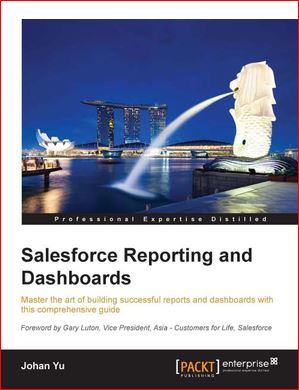
Book Review – “Salesforce Reporting and Dashboards” by Johan Yu

Recently I was reading the book – “Salesforce Reporting and Dashboards” by Johan Yu. 

Johan is a very familiar face within Salesforce community.
You can always reach Johan @simplysfdc, Linkedin and last but not the least his blog SimpleSFDC. I am a big fan of his blog.

The book – “Salesforce Reporting and Dashboards” contains a good selection of guides for solving reporting requirements. It started very well, I mean starting from very basic and then slowly moving towards more and more complex reporting requirements. When I started reading this book, I thought what makes this book different from Salesforce’s Trailhead session on reporting – Reports & Dashboards. And here is what I feel. When Trailhead session is good to make you comfortable with Salesforce’s Reporting concept, but still there are so many complex scenarios which you need to handle in your day to day work. And this book is definitely an answer to those complex scenarios. This book will make sure that you can call yourself a “Reporting and Dashboard Expert” once you have gone through the entire book. Yes you hear it correctly – It’s “Reporting and Dashboard Expert”.

I have experienced some difficulties during my career as Salesforce Administrator/Developer to provide solutions to some of my client’s reporting requirements. So when I was going through this book, I realized this book contains some effective remedies to many common problems. The solutions are provided in a very straightforward way – no unnecessary waffle – just straight to the point and explaining step by step how to implement the solution.

I personally love few sections from this book. Like
  • Hands-on – subscribing to a report – This really explains how to subscribe to a report and see the subscription in Salesforce1. Integration Salesforce1 in the hands-on is really a plus point to me.
  • Chapter 5 – Learning Advanced Report Configuration – This chapter is the jewel. Many important  configurations like bucket field, formula field, Grouping, Scheduling report etc. are explained here in a very simple way. To me this chapter is the one I need to refer again and again.
  • Chapter 8 – Accessing Historical Data – This is also a very important chapter. Accessing historical data over report is a very common requirements, but to implement the solution, one should have a very clear understanding on how it should be done, what can be done and what cannot be done. This chapter is a one stop shop for all these answers.
  • And finally Chapter 9 – Dashboard and Reports in Salesforce1 – Believe me this chapter is the differentiator. This chapter explains the concept and most important the limitations of Salesforce1 app. Understanding limitation is very important in the context of Salesforce and it will make the design more concrete.

In summary, if you are a Salesforce Admin looking to explore some of the advances concepts of Salesforce Reporting and Dashboard, then “Salesforce Reporting and Dashboards” is a must have. I am now encouraging all of my admin colleagues to read this book and challenge their solutions – because I believe by challenging ourselves, our best will come out.


You can buy this book from Amazon, PACKTPUB.

INTEGRATE MAPBOX WITH VISUALFORCE TO CREATE BEAUTIFUL MAP – Part III

In continuation with my previous two posts –

today, I will explain how you can fetch geographic data from Salesforce and accordingly show them in Salesforce.

To start with let me first create an object – Household where I can store geographic information. Below you can find the object details – 
Now the Visualforce page – Mapbox Click here
Now when you will open the page you will see the three locations plotted.
In this example, I am using apex:repeat to prepare the GeoJSON data. To understand what is GeoJSON data, below is what Wikipedia stating –
Once the GeoJSON data is ready, I am adding the same with featurelayer –
L.mapbox.featureLayer(geojson).addTo(map);

Finally, I am using the click event to show the Household name when user clicks on the points inside map. The code for that – 
//Show popup with information on mouse click
myLayer.on(‘click’,function(e){
     e.layer.openPopup();
}); 
In my next post, I will explain how you can draw geographic areas inside map using Mapbox. Please provide your feedback. Thanks.

INTEGRATE MAPBOX WITH VISUALFORCE TO CREATE BEAUTIFUL MAP – Part II

In continuation to my previous post – INTEGRATE MAPBOX WITH VISUALFORCE TO CREATE BEAUTIFUL MAP – Part I, today, I will play with few attributes from Mapbox to make the map more interactive.

Below are the things I will do –

  • I will add different layers and explain how to toggle between layers.
  • I will add scale control
  • I will add attribution control
  • I will set the location in the map
To understand what is layer and how Mapbox works, I would request you to go through the official Mapbox tutorial @ https://www.mapbox.com/guides/how-mapbox-works/. Since from this post, we will go into deep with Mapbox, so it is better to have your basic clear in terms of how Mapbox works and what are the terminologies they use.

Let’s go directly to the Visualforce Page Mapbox_2 click here
Now if you open the Visualforce page, you will see – 
Clicking on Layer icon, you will see –
Choosing Sudipta First Map, you will see different map like –
Cool!!. There are many more attributes available which you can check from Mapbox Developer resource @ https://www.mapbox.com/mapbox.js/api/v2.2.1/

In my next post, I will explain how you can retrieve geographical data from Salesforce object and show them in map with Mapbox API. Sounds interesting, right!! I am working on this now, very soon I will share the information with you all.

Till then, if you have any feedback, please share with me. Thanks.